
Employee engagement—a term often tossed around but rarely truly understood—holds the key to unlocking a company’s true potential. It’s not simply about happy employees; it’s about fostering a workforce deeply invested in the organization’s success. This exploration delves into the multifaceted nature of employee engagement, examining effective measurement strategies and providing actionable insights to cultivate a thriving, productive team.
Understanding employee engagement requires differentiating it from mere satisfaction or motivation. True engagement involves a profound sense of commitment, active involvement, and genuine enthusiasm for the work and the organization as a whole. This guide provides a framework for assessing engagement levels, identifying areas for improvement, and implementing strategies to foster a more engaged and productive workforce. We will explore various measurement methods, key metrics, data analysis techniques, and the crucial role of leadership in driving sustained engagement.
Methods for Measuring Employee Engagement
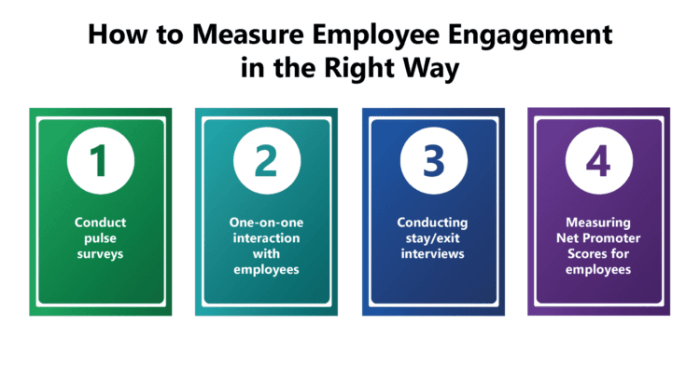
Measuring employee engagement effectively is crucial for organizational success. A comprehensive approach involves utilizing multiple methods to gain a holistic understanding of employee sentiment and experience. This allows for a more nuanced and accurate picture than any single method could provide.
Designing a Survey Instrument to Assess Employee Engagement
A well-designed survey is a cost-effective and efficient way to gather data from a large number of employees. The instrument should cover various aspects of the employee experience, including job satisfaction, organizational commitment, perceived support from management, opportunities for growth, and work-life balance. Questions should be clear, concise, and avoid leading language. A mix of question types, such as Likert scales, multiple-choice, and open-ended questions, is recommended to capture both quantitative and qualitative data.
Here’s an example of a survey instrument:
| Question | Question Type | Scale/Options |
|---|---|---|
| How satisfied are you with your current role? | Likert Scale | Very Dissatisfied – Very Satisfied (1-5) |
| Do you feel your contributions are valued by your team? | Multiple Choice | Yes/No/Sometimes |
| How would you describe your relationship with your manager? | Multiple Choice | Excellent/Good/Fair/Poor |
| What are the biggest challenges you face in your current role? | Open-ended | Text Box |
| Do you feel you have opportunities for professional development? | Likert Scale | Strongly Disagree – Strongly Agree (1-5) |
Comparing Different Methods for Measuring Employee Engagement
Several methods exist for measuring employee engagement, each with its own strengths and weaknesses. Surveys, interviews, focus groups, and observation all offer valuable insights, but their suitability depends on the specific context and objectives.
| Method | Advantages | Disadvantages | Data Type |
|---|---|---|---|
| Surveys | Cost-effective, reaches large numbers of employees, anonymous responses, quantifiable data | Can lack depth, response bias, low response rates, may not capture nuances of experience | Quantitative and Qualitative |
| Interviews | Provides rich qualitative data, allows for probing and clarification, builds rapport | Time-consuming, expensive, can be subjective, limited sample size | Qualitative |
| Focus Groups | Facilitates group discussion and identification of common themes, generates diverse perspectives | Can be dominated by certain individuals, scheduling difficulties, expensive | Qualitative |
| Observation | Provides direct insights into workplace behaviors and interactions, identifies patterns | Time-consuming, expensive, observer bias, can be intrusive | Qualitative |
The Role of Leadership in Employee Engagement
Leadership plays a pivotal role in cultivating a thriving and engaged workforce. A leader’s actions, communication style, and overall approach significantly influence the level of engagement within a team and the organization as a whole. Creating a positive and supportive work environment is not merely a desirable trait; it’s a fundamental requirement for driving employee engagement and achieving organizational success.Effective leadership fosters a culture where employees feel valued, respected, and empowered to contribute their best work.
This translates to increased productivity, improved morale, and reduced turnover. Conversely, poor leadership can lead to disengagement, decreased productivity, and a negative impact on the overall organizational climate.
Leadership Behaviors and Communication Styles that Promote Engagement
Effective leaders prioritize open and transparent communication, actively soliciting feedback from their teams and responding constructively to concerns. They foster a culture of trust and psychological safety, where employees feel comfortable expressing their opinions and ideas without fear of retribution. This includes actively listening to employee concerns, providing regular and honest feedback, and celebrating both individual and team successes.
For instance, a leader might implement regular one-on-one meetings to check in with team members, fostering a more personal connection and understanding of individual needs and challenges. They might also actively promote a culture of open dialogue during team meetings, encouraging questions and diverse perspectives. Furthermore, effective communication involves clarity in expectations, providing employees with a clear understanding of their roles, responsibilities, and the overall organizational goals.
Creating a Positive and Supportive Work Environment
Leaders can cultivate a positive and supportive work environment through several key strategies. Providing opportunities for professional development and growth demonstrates a commitment to employee well-being and career advancement. This could involve offering training programs, mentorship opportunities, or funding for further education. Leaders should also actively promote work-life balance, recognizing that employees have lives outside of work and supporting their efforts to maintain a healthy equilibrium.
This might include flexible work arrangements, generous paid time off, or initiatives promoting employee wellness. Finally, recognizing and rewarding employee contributions, both big and small, is crucial for fostering a sense of appreciation and motivating continued high performance. This could involve formal awards, public acknowledgment, or informal expressions of gratitude.
Five Leadership Practices Impacting Employee Engagement
Effective leadership practices significantly influence employee engagement. The following five practices illustrate this crucial connection:
- Clear Communication and Expectations: Leaders must clearly articulate goals, expectations, and feedback mechanisms. This clarity reduces ambiguity and empowers employees to understand their roles and contributions.
- Empowerment and Autonomy: Providing employees with autonomy and the authority to make decisions fosters a sense of ownership and responsibility, leading to increased engagement.
- Recognition and Appreciation: Regularly acknowledging and rewarding employee contributions, both big and small, strengthens morale and reinforces positive behaviors.
- Investment in Development: Supporting employee growth through training, mentorship, and development opportunities demonstrates a commitment to their future and increases their engagement.
- Building Trust and Psychological Safety: Creating a safe and inclusive environment where employees feel comfortable expressing their opinions and concerns without fear of judgment is essential for high engagement.
Maintaining and Sustaining Engagement
Maintaining high levels of employee engagement isn’t a one-time achievement; it’s an ongoing process requiring consistent effort and strategic adaptation. A proactive approach, incorporating regular monitoring and strategic adjustments, is crucial for preventing engagement levels from declining and fostering a thriving workplace culture. This involves understanding the dynamics of engagement, anticipating potential shifts, and proactively implementing measures to address emerging challenges.Ongoing monitoring and evaluation are essential for understanding the effectiveness of engagement initiatives and identifying areas for improvement.
Without this continuous feedback loop, organizations risk implementing strategies that are ineffective or even counterproductive. Regular data collection, analysis, and reporting provide valuable insights into employee sentiment, highlighting areas of strength and weakness within the engagement strategy. This data-driven approach allows for informed decision-making and the timely adjustment of strategies to maintain momentum and maximize impact.
Strategies for Sustaining Long-Term Engagement
Sustaining high employee engagement requires a multi-faceted approach that addresses both individual and organizational factors. Strategies should focus on fostering a culture of recognition, providing opportunities for growth and development, promoting work-life balance, and ensuring effective communication. This involves creating a supportive and inclusive environment where employees feel valued, respected, and empowered.
- Invest in employee development: Providing opportunities for training, skill enhancement, and career advancement demonstrates a commitment to employees’ professional growth and fosters a sense of loyalty and investment in the organization. This could involve offering tuition reimbursement, mentorship programs, or internal mobility opportunities.
- Foster open and transparent communication: Regular communication, including both top-down and bottom-up feedback mechanisms, keeps employees informed and involved. This might include regular town hall meetings, employee surveys, and open-door policies.
- Recognize and reward employees: A robust recognition program that acknowledges both individual and team accomplishments fosters a sense of appreciation and motivates employees to continue their high-level performance. This can range from formal awards to informal expressions of gratitude.
- Promote work-life balance: Offering flexible work arrangements, generous leave policies, and promoting a healthy work-life balance demonstrates respect for employees’ personal lives and reduces stress, contributing to improved engagement.
- Encourage employee feedback and involvement: Creating opportunities for employees to share their ideas, concerns, and suggestions demonstrates a commitment to their voices and promotes a sense of ownership and collaboration.
Examples of Organizations with High and Sustained Employee Engagement
While specific engagement data is often proprietary, several organizations are widely recognized for their commitment to employee well-being and high engagement levels. Companies like Google, known for its innovative workplace culture and employee benefits, and Southwest Airlines, renowned for its strong employee-centric culture, consistently rank highly in employee satisfaction surveys. These companies often invest heavily in employee training, development, and recognition programs, fostering a sense of community and purpose.
Their success demonstrates the long-term benefits of prioritizing employee engagement.
Structured Plan for Regular Reviews and Adjustments
A structured approach to reviewing and adjusting engagement strategies is crucial for maintaining effectiveness. This involves establishing a regular cadence for data collection, analysis, and action planning.
- Establish baseline metrics: Begin by establishing key performance indicators (KPIs) to measure employee engagement. This could include employee satisfaction scores, turnover rates, and productivity levels.
- Regular data collection: Implement a system for regularly collecting data on employee engagement, such as pulse surveys, focus groups, or 360-degree feedback.
- Data analysis and reporting: Analyze the collected data to identify trends and patterns, highlighting areas of strength and weakness in the current engagement strategy.
- Action planning and implementation: Develop and implement action plans based on the data analysis, focusing on addressing identified weaknesses and building on existing strengths.
- Evaluation and adjustment: Regularly evaluate the effectiveness of implemented actions and make adjustments as needed to optimize the engagement strategy.
Effectively measuring employee engagement is not a one-time event but an ongoing process of assessment, analysis, and improvement. By utilizing a combination of quantitative and qualitative data, organizations can gain a comprehensive understanding of their workforce’s engagement levels, pinpoint areas needing attention, and implement targeted strategies to foster a culture of commitment, involvement, and enthusiasm. The journey towards a highly engaged workforce requires consistent effort, transparent communication, and a genuine commitment from leadership to create a supportive and empowering work environment.
FAQ Section
What are some common signs of low employee engagement?
Signs include decreased productivity, high absenteeism, increased turnover, lack of initiative, negative attitudes, and poor communication.
How often should employee engagement be measured?
The frequency depends on organizational needs, but annual or bi-annual surveys are common, supplemented by regular pulse checks or informal feedback mechanisms.
How can I ensure my employee engagement survey is anonymous and confidential?
Use a third-party survey platform that guarantees anonymity, clearly state confidentiality in the survey introduction, and avoid collecting identifying information unless absolutely necessary.
What if my engagement survey reveals negative results?
Use the data to identify root causes, involve employees in developing solutions, and communicate transparently about the findings and the planned improvements.


